
Long description
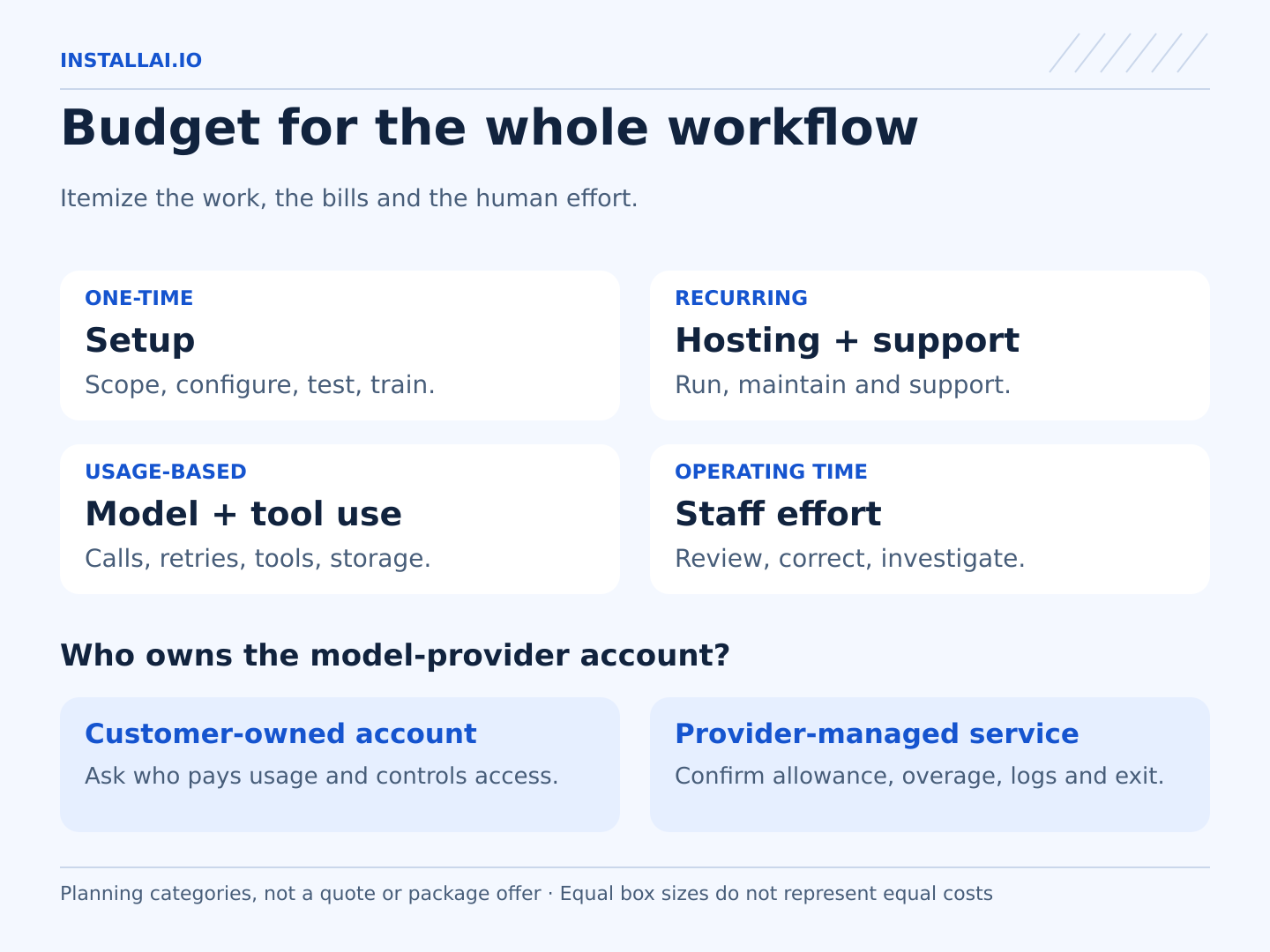
Four equal-sized blocks name cost categories without implying equal cost: setup and testing; hosting, maintenance, and support; model calls, tools, retries, and storage; and staff review, correction, and incident handling. Customer-owned and provider-managed accounts appear as conceptual arrangements, not advertised packages.
Start with the work being purchased
An AI setup can include discovery, configuration, account connections, testing and a team walkthrough. Those activities take effort even when the underlying software has a low monthly price. Ask for a written scope that names the workflow, tools, deliverables and completion criteria. Also ask what happens when a requested connection proves incompatible. A clear scope makes it easier to compare offers without assuming every provider includes the same work.
Separate the three main cost categories
First is implementation: the agreed work to get a defined setup ready. Second is recurring service: hosting, maintenance or support, depending on the package. Third is third-party usage: model calls, storage, connected software and other usage-based services. Ask who bills each category and which account owns it. An inexpensive hosting subscription should not be read as an unlimited allowance for custom workflows or AI usage.
Read the reference prices carefully
InstallAI’s reference monthly prices are $29 for Starter, $49 for Pro and $89 for Business. The mail-in setup reference is $1,500, and the on-site setup reference is $3,000. These amounts are conversation starting points; confirm currency, package inclusions and the total quote before purchasing. Do not add a monthly plan to a setup price automatically. Ask which combination actually fits the proposed work and which charges, if any, recur.
Estimate usage from a real example
Describe a typical task and estimate how often it runs. Include the information sent to the model, the expected output and whether the task needs additional tool calls or retries. Then measure a representative test using current provider rates. Infrastructure can have its own usage dimensions: Cloudflare Workers, for example, documents request and CPU-time charges, while other services have separate pricing. A single hosting figure cannot describe the complete application bill. Source: Cloudflare Workers pricing.
Ask about the practical extras
For on-site work, confirm location, travel arrangements and required hardware. For mail-in work, ask about shipping, packaging, insurance, device condition and return handling before sending anything. For all setups, check paid software licenses, support availability and the cost of later changes. These are questions to resolve in your quote; do not assume an extra is included or excluded because another company uses a similar package name.
Compare quotes using the same task
Two quotes are only comparable when they describe the same work. One might cover software installation and a basic demonstration; another might include workflow design, several connections and team training. Write the task and expected deliverables once, then ask each provider to identify what is included, what depends on compatibility and what would require another agreement. Compare the scope before deciding that the lower total represents better value.
Use a fictional quote review
Imagine Cedar Desk Demo wants drafts of project-note summaries. The proposed setup mentions a hosted tool and a monthly plan, but says nothing about the document connection or the person who maintains the approved source. The owner should ask whether those tasks are included, who owns the provider account and what happens if the connection needs repair. This hypothetical review uses no assumed price. Its purpose is to identify missing responsibilities before they turn into surprise work.
Check what happens after the demonstration
Ask who handles software updates, broken connections and changes to the workflow. Find out whether a later request is maintenance, support or a new project under the proposed agreement. Confirm how the business can stop a recurring service and what happens to its data and configuration afterward. Do not infer cancellation or refund rights from another provider’s website or from the word monthly. The applicable terms need to be supplied and understood before a commitment.
Bring five questions to the setup conversation
What specific result will be demonstrated at completion? Which accounts, hardware and subscriptions must the customer provide? Which amounts are one-time, recurring or based on usage? What work is excluded or still waiting on a compatibility check? Who approves a change that adds cost? Save the answers with the quote, together with the currency and any applicable conditions. This creates a useful reference when the project evolves. It also makes it easier to distinguish an ordinary operating charge from a request that changes the original scope.
Make the budget manageable
Choose a named person to review usage and approve changes. Ask which alerts and limits exist, and whether they stop spending or only send notifications. A budget email is not necessarily a hard cap. Include time for testing, corrections and team review when deciding whether the workflow is worthwhile. Your first cost estimate should be a short itemized plan with its assumptions visible. As usage becomes clearer, update that plan instead of relying on an untested promise of savings.
Sources checked
- Cloudflare: Workers pricing Checked 2026-10-10